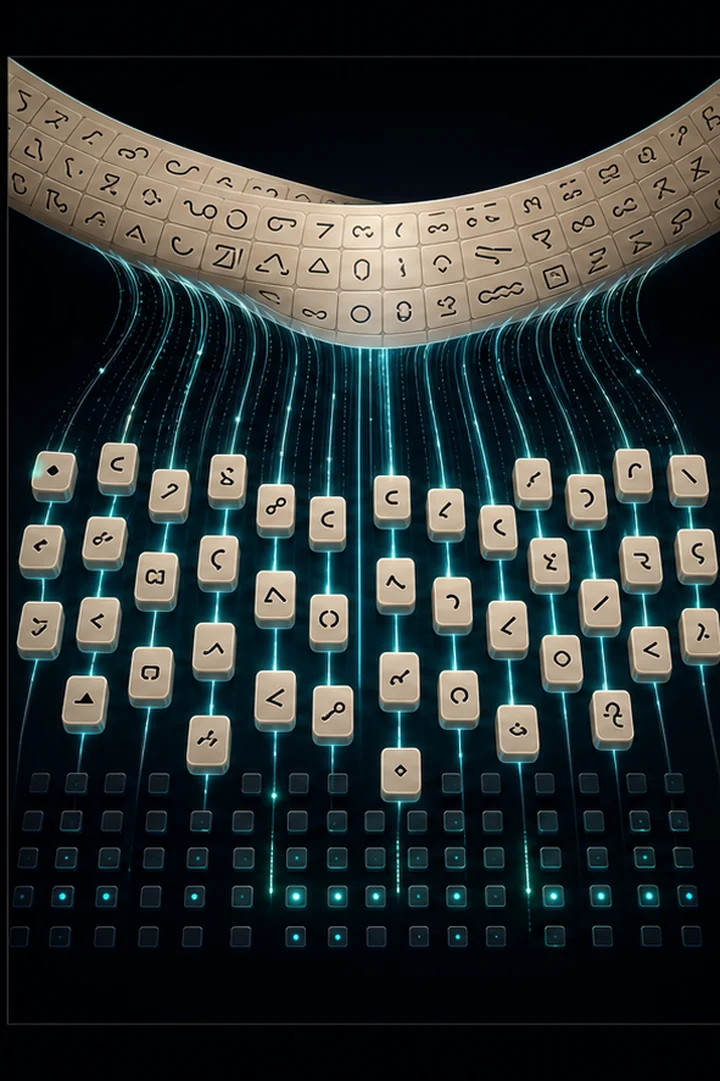
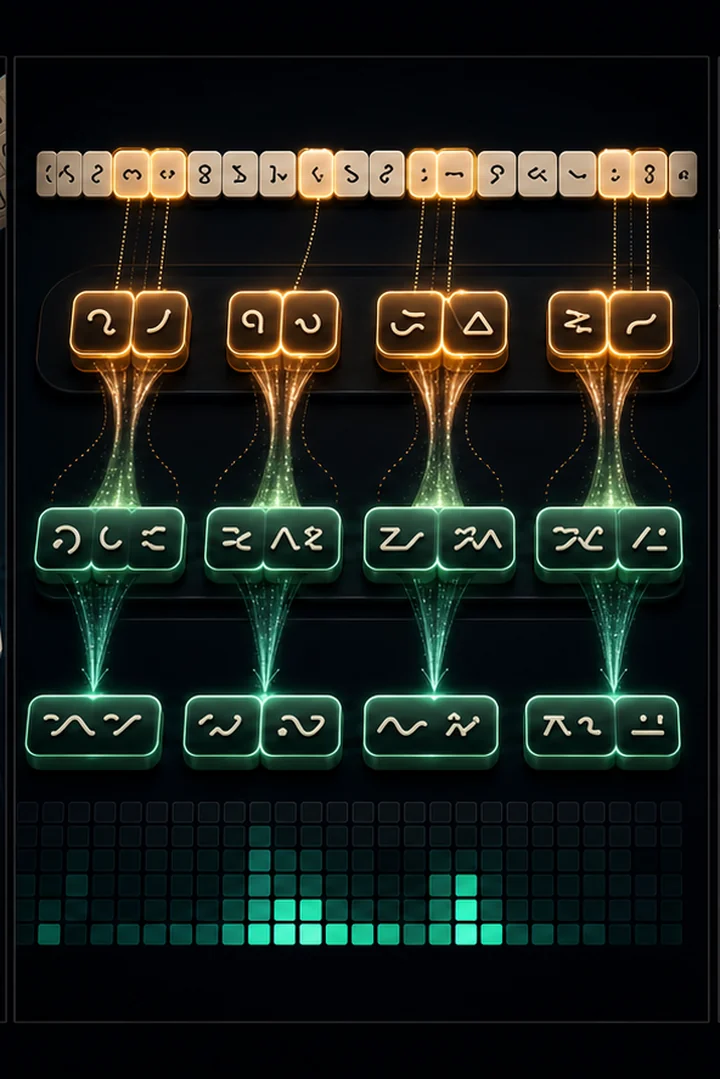
Models only understand numbers, so we need a reversible map between text and integer IDs. We build a character tokenizer, then a tiny BPE — the algorithm GPT actually uses, which greedily merges the most frequent adjacent pair into a new token, over and over.
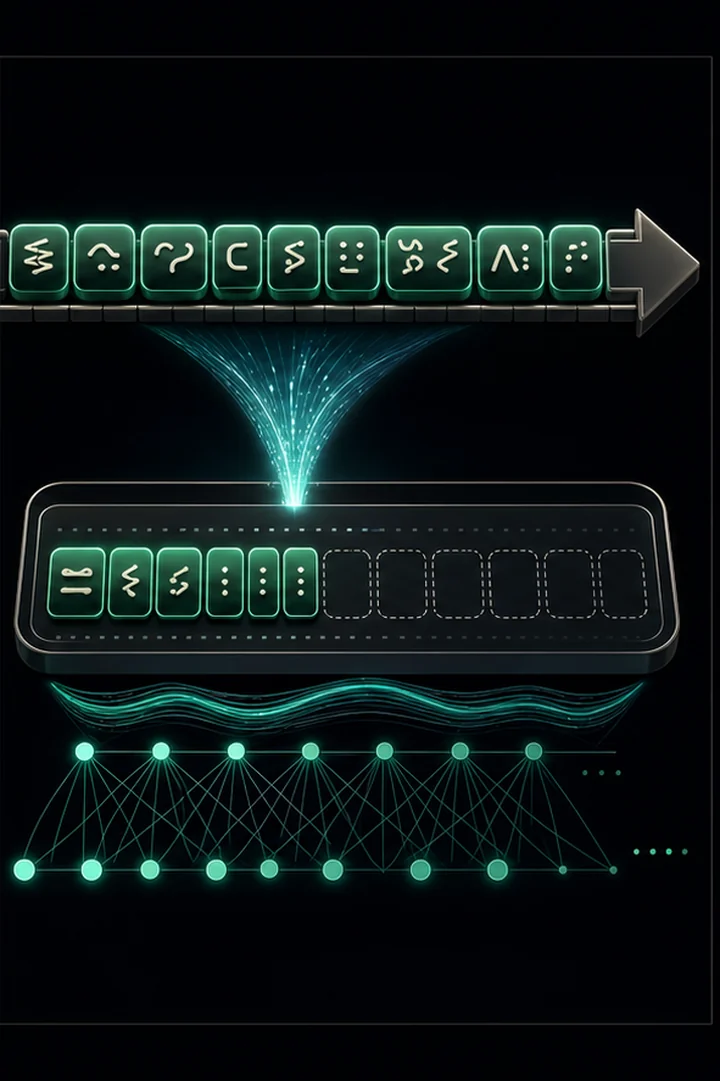
Watch it learn t,h → 'th' → 'the' → ' the'. Fewer tokens per word means more real text fits in the context window — the whole reason BPE beats characters.
A tokenizer is a reversible map between text and integer IDs, and its design is a trade-off between vocabulary size and sequence length. Character-level: tiny vocabulary, very long sequences, but never an unknown token. Word-level: short sequences, but a huge vocabulary and an out-of-vocabulary problem for any new word.
Byte-Pair Encoding finds the sweet spot. Starting from raw bytes/characters, it repeatedly merges the most frequent adjacent pair into a new subword token. Frequent chunks like the or ing become single tokens while rare words still decompose into pieces — an information-theoretic win, giving common patterns short codes. Modern LLMs use byte-level BPE for exactly this robustness, which is why fewer tokens per word means more text fits in the context window.
from collections import Counter


# --------------------------------------------------------------------------
# 1. Character-level tokenizer
# --------------------------------------------------------------------------
class CharTokenizer:
    """One token per unique character in the training text."""

    def __init__(self, text):
        chars = sorted(set(text))
        self.stoi = {c: i for i, c in enumerate(chars)}
        self.itos = {i: c for c, i in self.stoi.items()}
        self.vocab_size = len(chars)

    def encode(self, text):
        return [self.stoi[c] for c in text]

    def decode(self, ids):
        return "".join(self.itos[i] for i in ids)


# --------------------------------------------------------------------------
# 2. Byte-Pair Encoding (BPE) tokenizer
# --------------------------------------------------------------------------
class BPETokenizer:
    """Learn a vocabulary by repeatedly merging the most common adjacent pair.

    Start with raw bytes (0..255) so ANY text is representable. Then run
    `num_merges` rounds; each round finds the most frequent neighbouring pair
    of token IDs and assigns it a brand-new ID.
    """

    def __init__(self):
        self.merges = {}   # (id_a, id_b) -> new_id, in the order learned
        self.vocab = {i: bytes([i]) for i in range(256)}  # id -> raw bytes

    def _pair_counts(self, ids):
        return Counter(zip(ids, ids[1:]))

    def _merge(self, ids, pair, new_id):
        """Replace every occurrence of `pair` in `ids` with `new_id`."""
        out, i = [], 0
        while i < len(ids):
            if i < len(ids) - 1 and (ids[i], ids[i + 1]) == pair:
                out.append(new_id)
                i += 2
            else:
                out.append(ids[i])
                i += 1
        return out

    def train(self, text, num_merges=20):
        ids = list(text.encode("utf-8"))          # bytes -> initial token IDs
        for k in range(num_merges):
            counts = self._pair_counts(ids)
            if not counts:
                break
            pair = max(counts, key=counts.get)     # most frequent adjacent pair
            new_id = 256 + k
            ids = self._merge(ids, pair, new_id)
            self.merges[pair] = new_id
            # Record what bytes this new token expands to (for decoding).
            self.vocab[new_id] = self.vocab[pair[0]] + self.vocab[pair[1]]
        return self

    @property
    def vocab_size(self):
        return len(self.vocab)

    def encode(self, text):
        ids = list(text.encode("utf-8"))
        # Apply merges in the SAME order they were learned.
        for pair, new_id in self.merges.items():
            ids = self._merge(ids, pair, new_id)
        return ids

    def decode(self, ids):
        raw = b"".join(self.vocab[i] for i in ids)
        return raw.decode("utf-8", errors="replace")


# --------------------------------------------------------------------------
# Demo
# --------------------------------------------------------------------------text = "the theme of the theater is the thunder"
print("=== CharTokenizer ===")
ct = CharTokenizer(text)
ids = ct.encode("the theme")
print("vocab size:", ct.vocab_size)
print("encode('the theme') ->", ids)
print("decode back ->", repr(ct.decode(ids)))
print("\n=== BPETokenizer ===")
bpe = BPETokenizer().train(text, num_merges=10)
ids = bpe.encode("the theme")
print("vocab size:", bpe.vocab_size, "(256 bytes + learned merges)")
print("encode('the theme') ->", ids)
print("decode back ->", repr(bpe.decode(ids)))
print(f"'the theme' is {len('the theme')} chars but only {len(ids)} BPE tokens")
print("\nLearned merges (most common pairs became single tokens):")
for pair, new_id in bpe.merges.items():
piece = bpe.vocab[new_id].decode("utf-8", errors="replace")
print(f" {pair} -> {new_id} = {piece!r}")=== CharTokenizer ===
vocab size: 14
encode('the theme') -> [12, 5, 3, 0, 12, 5, 3, 7, 3]
decode back -> 'the theme'
=== BPETokenizer ===
vocab size: 266 (256 bytes + learned merges)
encode('the theme') -> [262]
decode back -> 'the theme'
'the theme' is 9 chars but only 1 BPE tokens
Learned merges (most common pairs became single tokens):
(116, 104) -> 256 = 'th'
(256, 101) -> 257 = 'the'
(32, 257) -> 258 = ' the'
(101, 114) -> 259 = 'er'
(257, 258) -> 260 = 'the the'
(260, 109) -> 261 = 'the them'
(261, 101) -> 262 = 'the theme'
(262, 32) -> 263 = 'the theme '
(263, 111) -> 264 = 'the theme o'
(264, 102) -> 265 = 'the theme of'