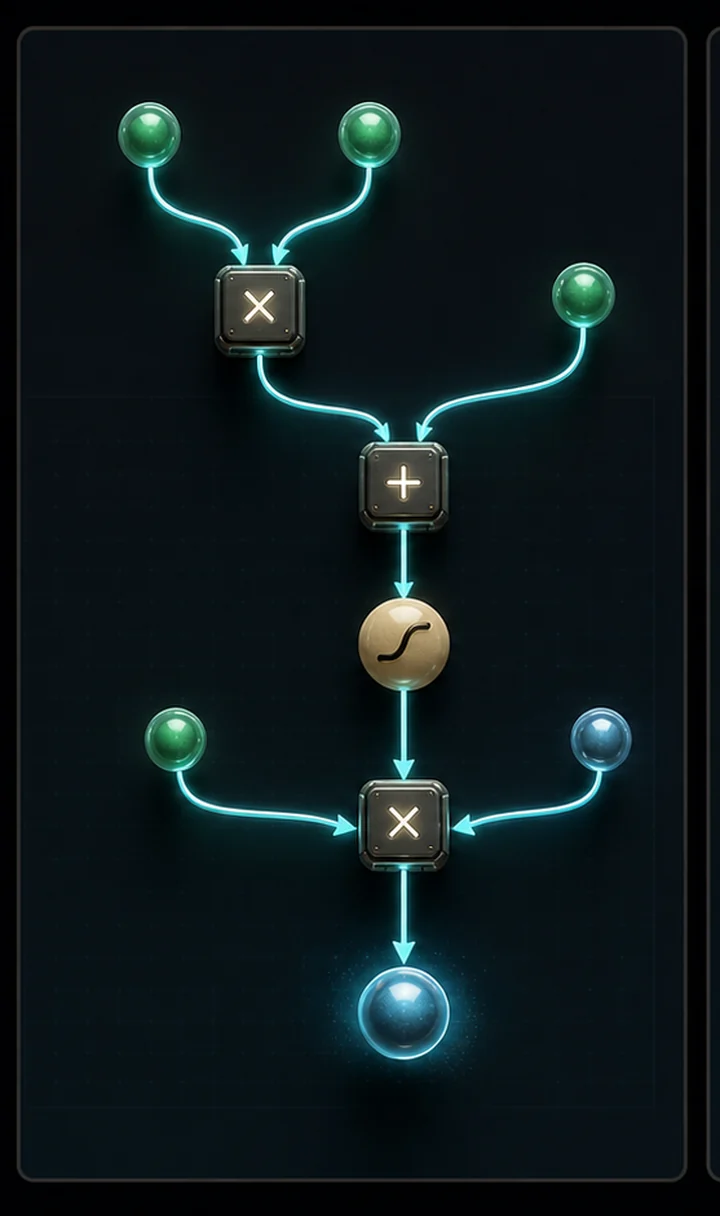
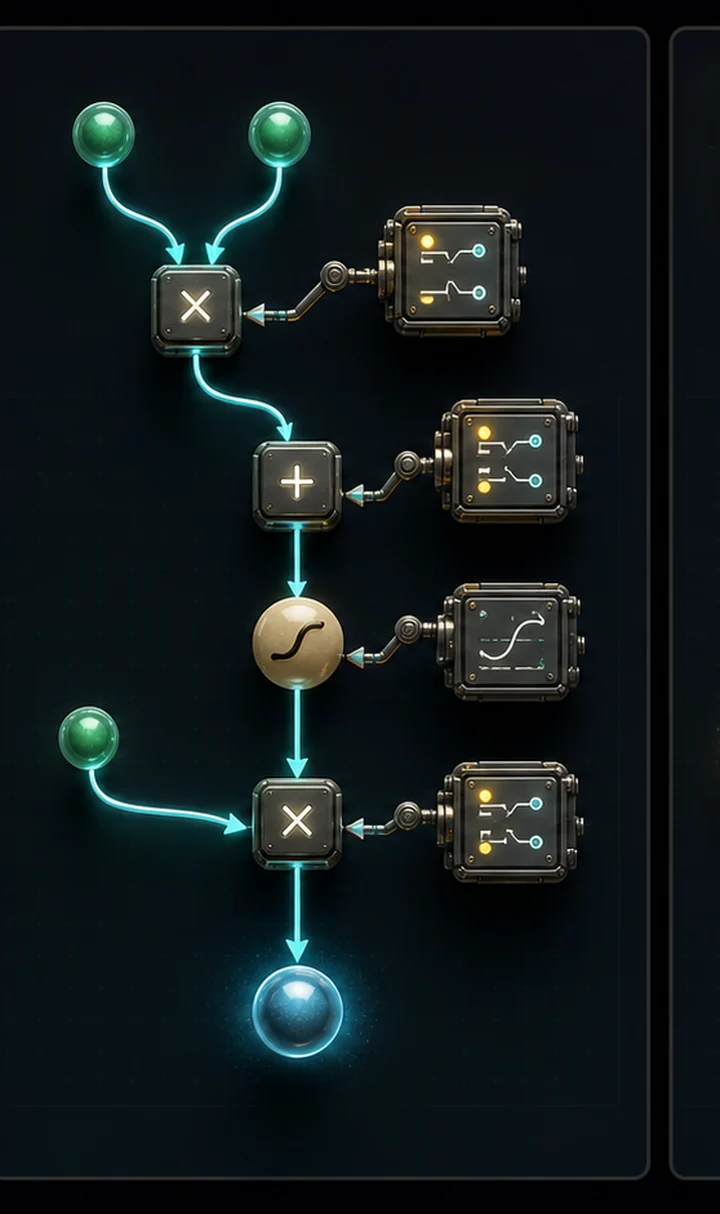
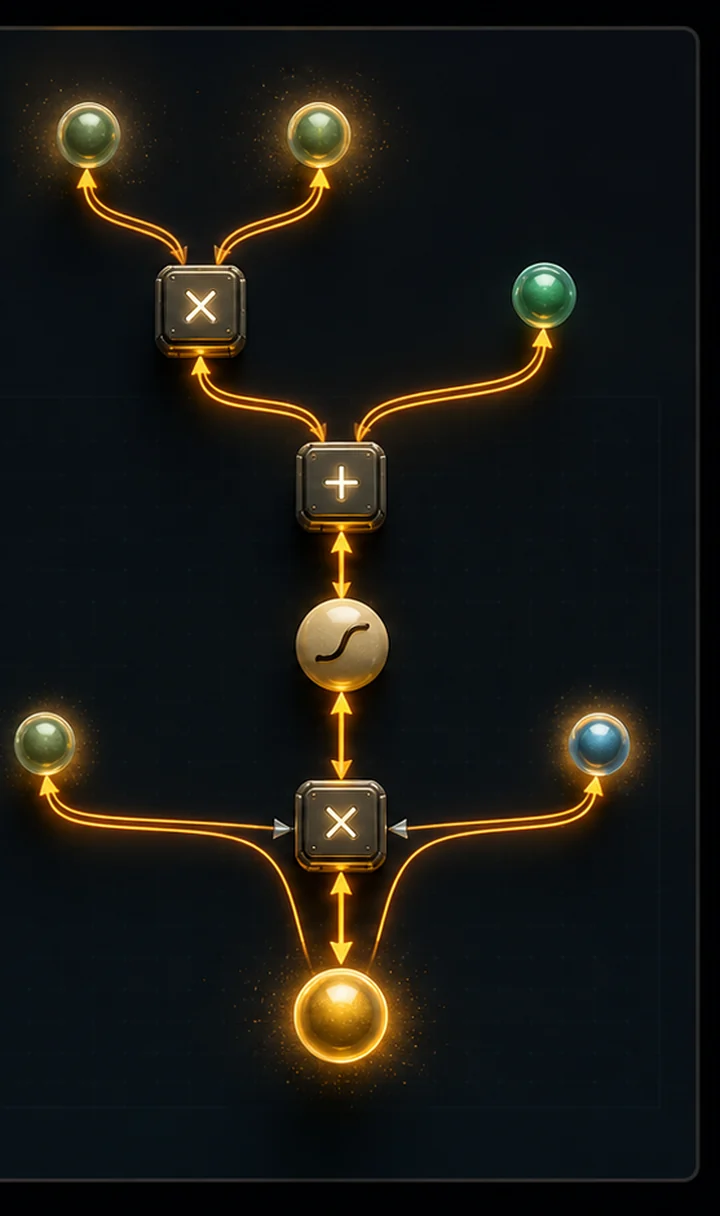
We've hand-derived gradients three times. PyTorch does it automatically — and here's how, in miniature. Every Value remembers its parents and a local rule for one step of the chain rule. Calling .backward() walks the graph in reverse and assembles the whole derivative.
The proof: the auto-computed gradient matches a numerical estimate exactly. You write only the forward math; the backward pass builds itself. That's all PyTorch's autograd is.
Hand-deriving gradients doesn't scale, so frameworks use reverse-mode automatic differentiation. As the forward pass runs, it records a computational graph: every intermediate value remembers which values produced it and a local rule for its derivative. This is not numerical approximation nor symbolic algebra — it's exact, computed by composing local derivatives.
The backward pass walks that graph from the output back to the inputs in topological order, multiplying and accumulating local derivatives (the chain rule) to get ∂loss/∂parameter for every parameter at once. Remarkably, the whole backward pass costs about the same as one forward pass — which is what makes training networks with billions of parameters feasible.
import math


class Value:
    """A single scalar that tracks how it was computed, so it can backprop."""

    def __init__(self, data, _parents=(), _op=""):
        self.data = data
        self.grad = 0.0                 # d(final output) / d(this value)
        self._parents = set(_parents)
        self._op = _op                  # label, for debugging/printing
        self._backward = lambda: None   # how to push grad to parents

    def __repr__(self):
        return f"Value(data={self.data:.4f}, grad={self.grad:.4f})"

    # --- Operations. Each builds a new Value AND defines its local backward. ---

    def __add__(self, other):
        other = other if isinstance(other, Value) else Value(other)
        out = Value(self.data + other.data, (self, other), "+")

        def _backward():
            # d(a+b)/da = 1, d(a+b)/db = 1  -> gradient flows through unchanged.
            self.grad += out.grad
            other.grad += out.grad
        out._backward = _backward
        return out

    def __mul__(self, other):
        other = other if isinstance(other, Value) else Value(other)
        out = Value(self.data * other.data, (self, other), "*")

        def _backward():
            # d(a*b)/da = b, d(a*b)/db = a
            self.grad += other.data * out.grad
            other.grad += self.data * out.grad
        out._backward = _backward
        return out

    def __pow__(self, power):
        out = Value(self.data ** power, (self,), f"**{power}")

        def _backward():
            self.grad += (power * self.data ** (power - 1)) * out.grad
        out._backward = _backward
        return out

    def tanh(self):
        t = math.tanh(self.data)
        out = Value(t, (self,), "tanh")

        def _backward():
            # d(tanh(x))/dx = 1 - tanh(x)^2  — the same rule we used in #4.
            self.grad += (1 - t ** 2) * out.grad
        out._backward = _backward
        return out

    # Conveniences so we can write natural expressions.
    def __neg__(self):           return self * -1
    def __sub__(self, other):    return self + (-other)
    def __radd__(self, other):   return self + other
    def __rmul__(self, other):   return self * other

    def backward(self):
        """Run the chain rule over the whole graph, leaf-ward from `self`."""
        # 1. Topologically order every node behind this one.
        topo, visited = [], set()

        def build(v):
            if v not in visited:
                visited.add(v)
                for parent in v._parents:
                    build(parent)
                topo.append(v)
        build(self)

        # 2. Seed: d(self)/d(self) = 1, then apply each _backward in reverse.
        self.grad = 1.0
        for node in reversed(topo):
node._backward()# A tiny neuron: out = tanh(w1*x1 + w2*x2 + b)
x1, x2 = Value(2.0), Value(0.0)
w1, w2 = Value(-3.0), Value(1.0)
b = Value(6.88)
n = x1 * w1 + x2 * w2 + b
out = n.tanh()
print("forward output:", out)
out.backward() # <-- gradients computed automatically, no hand-derivation
print("\ngradients (how each input nudges the output):")
print(f" x1.grad = {x1.grad:.4f}")
print(f" w1.grad = {w1.grad:.4f}")
print(f" x2.grad = {x2.grad:.4f}")
print(f" w2.grad = {w2.grad:.4f}")
print(f" b.grad = {b.grad:.4f}")
# Sanity check w1.grad numerically: nudge w1 a hair and see how out moves.
eps = 1e-6
base = (x1.data * w1.data + x2.data * w2.data + b.data)
f = lambda w: math.tanh(x1.data * w + x2.data * w2.data + b.data)
numeric = (f(w1.data + eps) - f(w1.data)) / eps
print(f"\nnumeric check of w1.grad: {numeric:.4f} (should match above)")forward output: Value(data=0.7064, grad=0.0000) gradients (how each input nudges the output): x1.grad = -1.5029 w1.grad = 1.0019 x2.grad = 0.5010 w2.grad = 0.0000 b.grad = 0.5010 numeric check of w1.grad: 1.0019 (should match above)