A bare loop won't survive a multi-day run. This adds resumable checkpoints (model + optimizer + step), a learning-rate schedule (warmup then cosine decay), gradient clipping, and best-model tracking.
Run it once, stop, run it again — it picks up exactly where it left off. That's how real training survives crashes and restarts.
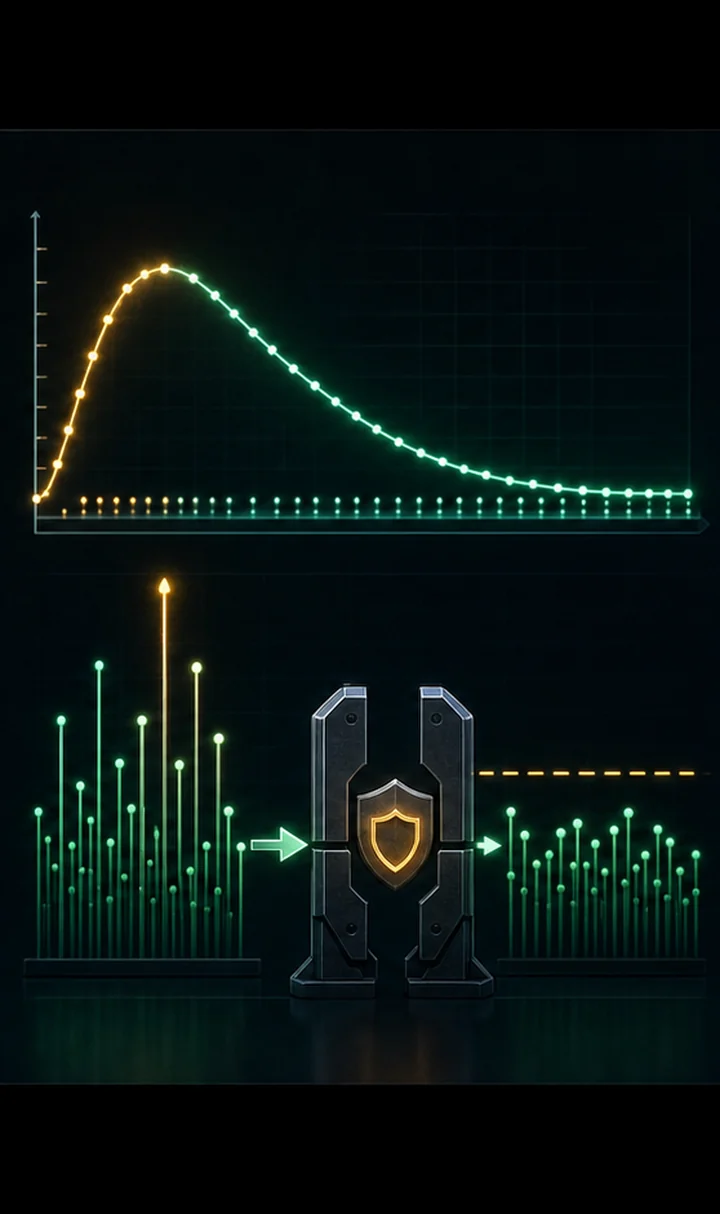
Real training needs more than a loop. A learning-rate schedule — a linear warmup followed by cosine decay — starts small to avoid instability when early gradients are large and poorly conditioned, then anneals to refine the solution. Gradient clipping caps the gradient norm so a single pathological batch can't blow the weights to infinity.
Checkpointing the model, optimizer state, and step count makes a run resumable — essential for multi-day training and crash recovery — while tracking the best validation loss guards against overfitting. AdamW decouples weight decay from the gradient update, a small change that consistently improves generalization. These are the unglamorous details that separate a toy loop from a real training run.


import importlib.util
import math
import os
from pathlib import Path

import torch

# Resolve paths from the repo root (works from any CWD and in notebooks).
ROOT = Path(__file__).resolve().parents[2] if "__file__" in globals() else Path.cwd()
ASSETS = ROOT / "assets"

# Reuse everything from #9 (digit-prefixed filename -> load as a module).
spec = importlib.util.spec_from_file_location(
    "tiny_gpt", str(ROOT / "steps" / "04_transformer" / "09_tiny_gpt.py"))
tg = importlib.util.module_from_spec(spec)
spec.loader.exec_module(tg)

DEVICE = tg.DEVICE

# ---- Training config ----
TARGET_ITERS = 1500       # total iterations to reach (across all runs)
WARMUP_ITERS = 100        # ramp LR up over the first N steps
MAX_LR = 3e-3
MIN_LR = 3e-4
EVAL_INTERVAL = 250
GRAD_CLIP = 1.0
CKPT_PATH = str(ASSETS / "train_ckpt.pt")   # full training state (resumable)
BEST_PATH = str(ASSETS / "train_best.pt")   # lowest-val-loss weights only


def get_lr(it):
    """Linear warmup for WARMUP_ITERS, then cosine decay down to MIN_LR."""
    if it < WARMUP_ITERS:
        return MAX_LR * (it + 1) / WARMUP_ITERS
    # Cosine decay from MAX_LR -> MIN_LR over the remaining iterations.
    progress = (it - WARMUP_ITERS) / max(1, TARGET_ITERS - WARMUP_ITERS)
    coeff = 0.5 * (1 + math.cos(math.pi * min(progress, 1.0)))
    return MIN_LR + coeff * (MAX_LR - MIN_LR)


def save_checkpoint(model, optimizer, it, best_val):
    torch.save({
        "model": model.state_dict(),
        "optimizer": optimizer.state_dict(),
        "iter": it,
        "best_val": best_val,
        "chars": tg.chars,
    }, CKPT_PATH)


def main():
    model = tg.TinyGPT().to(DEVICE)
    optimizer = torch.optim.AdamW(model.parameters(), lr=MAX_LR)

    start_iter, best_val = 0, float("inf")

    # --- Resume if a checkpoint exists ---
    if os.path.exists(CKPT_PATH):
        ckpt = torch.load(CKPT_PATH, map_location=DEVICE)
        model.load_state_dict(ckpt["model"])
        optimizer.load_state_dict(ckpt["optimizer"])
        start_iter = ckpt["iter"]
        best_val = ckpt["best_val"]
        print(f"resumed from {CKPT_PATH} at iter {start_iter} "
              f"(best val {best_val:.3f})")
    else:
        print("no checkpoint found — starting fresh")

    if start_iter >= TARGET_ITERS:
        print(f"already trained to {start_iter} >= target {TARGET_ITERS}. "
              f"Increase TARGET_ITERS or delete {CKPT_PATH} to train more.")
        return

    print(f"training iters {start_iter} -> {TARGET_ITERS}\n")

    for it in range(start_iter, TARGET_ITERS):
        # Set this step's learning rate from the schedule.
        lr = get_lr(it)
        for group in optimizer.param_groups:
            group["lr"] = lr

        if it % EVAL_INTERVAL == 0:
            losses = tg.estimate_loss(model)
            print(f"iter {it:4d}  lr {lr:.1e}  "
                  f"train {losses['train']:.3f}  val {losses['val']:.3f}")
            # Keep the best-on-validation weights separately.
            if losses["val"] < best_val:
                best_val = losses["val"]
                torch.save({"model": model.state_dict(), "chars": tg.chars},
                           BEST_PATH)

        x, y = tg.get_batch(tg.train_data)
        _, loss = model(x, y)
        optimizer.zero_grad(set_to_none=True)
        loss.backward()
        # Clip gradients so a single bad batch can't destabilize training.
        torch.nn.utils.clip_grad_norm_(model.parameters(), GRAD_CLIP)
        optimizer.step()

    # Final eval + save so the next run resumes from here.
    losses = tg.estimate_loss(model)
    print(f"iter {TARGET_ITERS:4d}  train {losses['train']:.3f}  "
          f"val {losses['val']:.3f}")
    if losses["val"] < best_val:
        best_val = losses["val"]
        torch.save({"model": model.state_dict(), "chars": tg.chars}, BEST_PATH)
    save_checkpoint(model, optimizer, TARGET_ITERS, best_val)
    print(f"\nsaved resumable state -> {CKPT_PATH}")
print(f"saved best (val {best_val:.3f}) -> {BEST_PATH}")main()resumed from /Users/anchitgupta/Documents/Github/learn_llm_code/assets/train_ckpt.pt at iter 1500 (best val 1.757) already trained to 1500 >= target 1500. Increase TARGET_ITERS or delete /Users/anchitgupta/Documents/Github/learn_llm_code/assets/train_ckpt.pt to train more.